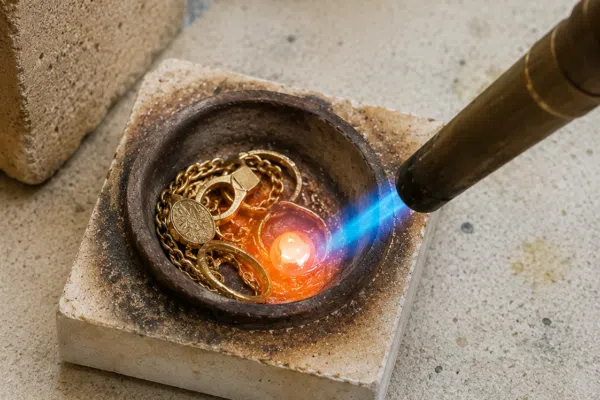
Can I just put my old gold in the crucible?
“Can you melt down these old rings and make something new out of them?”
I get asked that question all the time. Sometimes there’s a handful of pieces of jewelry on my workbench: a wedding ring from Grandma, a broken necklace, a signet ring that nobody likes, and a single earring whose pair probably went missing somewhere back in 1997. The short answer is: often, yes.
The slightly longer goldsmith's answer is, of course: it depends.
Old gold is a beautiful material
Gold has a major advantage: you can reuse it over and over again. So a piece of jewelry doesn’t have to be the end of the line for the material. I think that’s one of the most beautiful aspects of my craft. A ring that’s sat unused in a box for years can eventually be transformed into a piece of jewelry that’s worn every day. And if the gold comes from parents or grandparents, a piece of the original piece of jewelry is literally preserved.
Especially now that gold is so valuable, it makes financial sense to first take a look at what’s already in my jewelry box before ordering new gold. But before I eagerly light the burner, I do want to know exactly what I’m putting into that crucible.
14 karat isn't always the same as 14 karat
A 14-karat gold piece of jewelry consists of 58.5 percent pure gold. The remaining 41.5 percent consists of other metals, usually including silver and copper. These metals determine, for example, the color and hardness of the gold.
And that’s where things get interesting. Two pieces of jewelry can both be 14-karat yellow gold and still have different compositions. Add an old repair, a few solder joints, and perhaps a component of unknown origin, and suddenly you have a pretty interesting mix in your crucible.
That doesn't have to be a problem, but it could become one. Impurities and solder residue can cause melted gold to crack or become brittle during rolling or bending. The final color may also turn out differently than expected. That's why I carefully examine old gold first before deciding how to process it.
Can yellow gold be worn with white gold?
Technically, you can remelt various gold alloys. But that doesn't automatically give you a beautiful new gold color.
Yellow gold, rose gold, and white gold contain different alloying metals. If you mix them all together, you create a new alloy whose color and properties depend on what you’ve put into it. Similarly, different gold finenesses cannot simply be combined if the final product must have a guaranteed fineness.
That is why it is sometimes wiser to keep the gold separate, add other materials, or avoid using the old gold directly in the new piece of jewelry.
That might sound less romantic than “everything comes together in a single melting pot,” but in the end, I’d rather make a good piece of jewelry than a beautiful story with a flaw in it.
What about the stones?
Those, too, can often be reused.
Diamonds are ideal for this. Many other gemstones can also be removed from an old piece of jewelry and reset, provided they are still in good condition and suitable for the new design.
Sometimes it is precisely such an existing stone that serves as the starting point for the design.
I often find that much more interesting than trying to recreate the old piece of jewelry in a slightly more modern version. After all, we don't have to pretend it's still 1974 just because the diamond happens to be from 1974.
Do I have enough gold?
That's another frequently asked question.
The weight of the old jewelry isn’t necessarily the same as the weight of material I have available for the new piece. Stones, clasps, springs, and parts made of other metals obviously don’t count toward that weight. Furthermore, I often need more material to make a piece of jewelry than is ultimately used in the finished piece.
To make a ring weighing, say, five grams, I can't start with exactly five grams of gold. I need to be able to hold the material, roll it, cut it, file it, and finish it. So I need enough material to work with.
If you don't have enough suitable gold, I can usually add more.
Does my own gold have to be used in my new piece of jewelry?
That's actually the most important question.
For some people, it’s essential. When their parents’ wedding rings are melted down, they want that very gold to be used in their new ring. The emotional value lies not only in the memory, but also in the material itself.
For someone else, that matters much less. That person has a collection of old jewelry whose value lies primarily in the gold.
In that case, it may sometimes be wiser to offset the value of the old gold and have the new piece of jewelry made from a well-known, new alloy.
So there is no standard answer.
From a jewelry drawer to a workbench
Do you have any old gold jewelry lying around at home that you no longer wear? Don’t throw it away. And don’t go pulling all the stones out yourself with a pair of combination pliers—that usually doesn’t make the goldsmith very happy.
Just bring them along.
I can assess which gold is usable, what might be combined, which stones can be reused, and how much material is needed for the design you have in mind.
Maybe Grandma's wedding ring will eventually become a new wedding ring, a pendant, or something completely different.
Because a memory doesn't have to remain in the same form to be preserved.
