
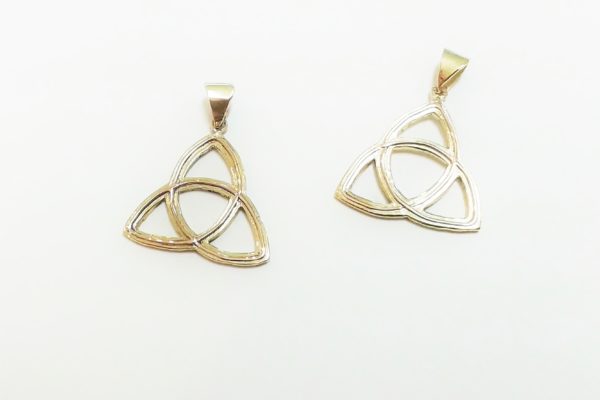
The same piece of jewelry. Or is it?
Why two pieces of jewelry that look alike can still be very different
I regularly get emails from people who’ve seen a piece of jewelry somewhere on the internet. They include a photo, and the question usually follows: “Can you make something like that? And how much would it cost?”
That’s a fair question. After all, we all compare prices before we buy something. But when it comes to handmade jewelry, it’s a little more complicated. That’s because two pieces of jewelry that look almost identical in a photo can actually differ quite a bit in reality. And I’m not just talking about the price.
A knot that isn't really a knot
I recently received a request for a gold pendant featuring a heart and a knot intertwined. The customer had found an example at another jeweler and wanted to know if I could make something like that.
I certainly can. In fact, for about the same price, I can create a piece that I think is even more beautiful. The example looks as if it were cast from a single piece. The lines that appear to run over and under one another are indicated by notches in the surface. So the intertwining is mainly visual. When I make a pendant like this, I build up the center and the knot from separate parts that are actually woven together. Just as a knot should truly be a knot. It’s more work, but the result has real depth. The lines flow more naturally, and the piece as a whole takes on a sense of depth that you simply can’t achieve with just a few notches.
So the difference lies not only in what you see, but mainly in how the piece of jewelry is made.
Not everything that looks alike is the same
A piece of jewelry can be cast, stamped, machine-made, or assembled entirely by hand. None of these techniques is inherently wrong. Even casting can yield beautiful results, as long as you finish the material properly after casting (which is where things often fall short). The chosen technique, the level of detail, and—above all—the finish play a major role in determining the quality and appearance of the final product. Are the lines clean and crisp? Are the transitions carefully finished? Does the design truly have depth, or is it merely suggested? And has attention been paid to the back, which you usually don’t see in a web store photo?
Those are the kinds of things I automatically look for as a goldsmith. A professional habit, let’s just say. Fortunately, there are also customers who notice that difference. For example, I recently received a comment on my gold ginkgo biloba leaf. The customer had found a cheaper version elsewhere, but thought mine was much more beautiful. See, that makes me happy. Not because my pendant was more expensive, but because someone saw why it was different.
But do you just copy other jewelers' designs like that?
No, generally speaking, no. When a colleague has created an original design, I think you should respect that. Someone has invested time, knowledge, and creativity into developing something unique. I don't just blindly copy that.
But there is a difference between a unique design and a widely recognized symbol or a classic piece of jewelry. A heart, a tree of life, a Celtic knot, or a ginkgo biloba leaf is not the exclusive design of a single goldsmith. The same applies to classic pieces of jewelry such as a solitaire ring, a signet ring, or a simple wedding band. These shapes and symbols have existed for a very long time and are interpreted in their own unique ways by countless goldsmiths.
So I’m perfectly capable of making a pendant with a heart and a knot, or crafting a classic solitaire ring. It’s just that I create my own version of it, with my own technical choices, detailing, and finish. And sometimes that means the result differs quite a bit from the example a customer brought in.
How much does it cost to make something like that?
Of course, that remains to be seen. A handmade piece of jewelry isn’t necessarily more expensive than a comparable piece from a regular jewelry store or online shop. It depends, among other things, on the material, the weight, the complexity, and the production method.
But it’s not necessarily cheaper, either. When I craft a piece of jewelry entirely by hand, you’re not just paying for a certain amount of gold. You’re also paying for the design, the construction, the soldering, the filing, the sanding, the polishing, and all the other steps required to turn an idea into a beautifully finished piece of jewelry. And for my experience and craftsmanship.
So if you send me a photo and ask if I can make something similar, I’d be happy to take a look at it. Maybe I can do it for about the same price. Maybe it’ll cost more. And sometimes I can even suggest a design that’s technically or aesthetically superior. But one thing is certain: I look beyond just the picture. Because two pieces of jewelry might look the same at first glance—until you take a closer look.
